Tailor Efficiency Prediction & Cooperative Management System
A machine-learning workforce efficiency prediction system combined with a cooperative management platform for operational decision-making.
Overview
A dual-module system combining machine learning for workforce efficiency prediction with a full cooperative management platform. Modules include tailor efficiency prediction, operational dashboard, tailor management, stock management, supplier management, and purchase management.
Problem
Cooperative managers lack data-driven tools to assign work to the most efficient tailors and manage operations across multiple business functions.
Target Users
Cooperative managers and operational staff
My Role
Cross-functional team member
Worked across the product process, led financial-model and IRR validation, contributed to system architecture, backend and administration design, and developed the operational interface.
Key Features
- ML-based tailor efficiency prediction model
- Operational dashboard for cooperative managers
- Tailor, stock, supplier, and purchase management modules
- Cooperative operational workflow automation
- Financial model and IRR validation
AI System Notes
Machine-learning prediction and rule-based allocation layer over cooperative operations data.
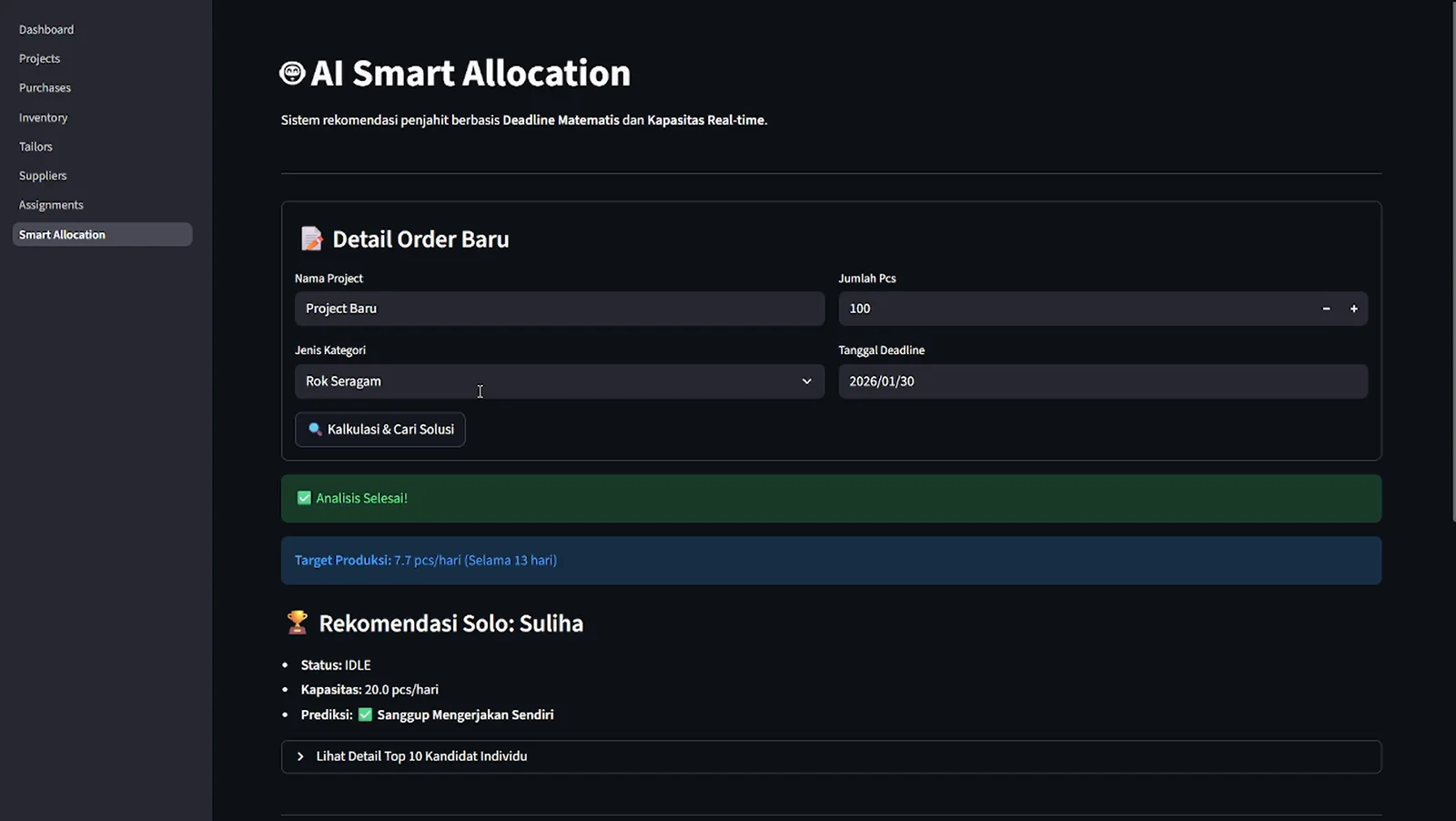
Operational tables feed dashboards, tailor management, and allocation recommendations in the cooperative system.
Recommendations are checked against deadline math, capacity, current status, specialty, and distance.
When no single tailor is enough, the system proposes a custom split order instead of forcing one assignment.
Competition prototype using limited operational data; model confidence needs real deployment data before production use.
Pipeline
- Tailor records capture speed, status, distance, specialty, and available capacity.
- Order inputs define category, quantity, and deadline pressure.
- The allocation layer estimates required daily production and ranks feasible tailors.
- If single-tailor capacity is unsafe, the system simulates split-order alternatives.
Challenges & Trade-offs
- Training reliable prediction models with limited operational data
- Integrating ML predictions into practical operational workflows
- Coordinating across multidisciplinary team members (Business, Architecture, International Business)
Results
2nd Place — SUTD × Petra Christian University International Hackathon, January 2026.
Proof Artifacts


